When a brand searches for an OEM ODM bag manufacturer, the real question is usually not only who can sew a bag. Sourcing teams need a development partner that can read a product brief, translate construction details into a workable sample, control material and trim choices, and prepare production in a way that reduces avoidable surprises. For seasonal collections, private label launches, corporate programs, and product line extensions, the early manufacturing decisions often shape cost, handfeel, lead time, and inspection results.
Connect5 Bags works with B2B buyers that need a structured path from idea to export-ready production. The model is centered on China sampling support, practical sourcing coordination, and Cambodia production planning. That means the buyer should approach the process with a clear brief, but does not need to solve every technical question before contacting the factory team. The role of a manufacturer is to help convert the brief into material options, construction logic, sample comments, production files, and quality checkpoints.
OEM and ODM mean different buying workflows
OEM, ODM, and private label are often used loosely, but they create different responsibilities for the brand and the factory. In an OEM program, the brand normally brings the design direction, measurements, artwork, material preferences, packaging requirements, and target market information. In an ODM program, the buyer may start from an existing construction direction or a manufacturer-developed concept, then modify materials, dimensions, trims, and branding details. Both paths can be useful, but they require different levels of documentation and review.
For buyers that are still defining the range, the OEM bag manufacturer page and the broader custom bag manufacturer overview are useful starting points. They help sourcing teams decide whether they need full custom development, adaptation of an existing bag type, or a mixed approach across several SKUs.
| Manufacturing route | Typical buyer input | Factory focus | Useful when |
|---|---|---|---|
| OEM | Tech pack, reference sample, artwork, material target, size specification | Pattern development, sampling, material matching, production control | The brand owns a defined design and needs reliable execution |
| ODM | Design direction, target function, logo method, price band, market positioning | Concept adaptation, sample proposal, material and trim suggestions | The buyer wants to speed up development without starting from a blank page |
| Private label | Branding, packaging, selected silhouette, order plan, compliance expectations | Customization, labeling, packaging coordination, QC alignment | The brand wants a controlled branded program with limited engineering load |
| Trading company route | Inquiry list and commercial target | Supplier matching and order coordination | The buyer needs market access but may have less direct factory communication |
Start the RFQ with a decision-ready brief
A short request such as please quote a tote bag leaves too much room for assumptions. A decision-ready RFQ should show what the bag must do, who will use it, and which parts of the design are flexible. A structured RFQ helps the manufacturer choose relevant materials, estimate sample effort, and identify construction details that may affect cost or lead time.
Useful RFQ inputs
- Bag type, size range, carrying method, pocket structure, lining requirement, and closure type.
- Target materials, such as PU, canvas, nylon, suede, raffia, polyester, mesh, or mixed-material panels.
- Hardware and trims, including zipper type, puller shape, buckle finish, logo plate, webbing width, elastic, rivets, and packaging trims.
- Branding method, such as woven label, heat transfer, embossing, metal logo plate, hangtag, or custom packaging.
- Estimated order quantity by color, SKU, and delivery window, with target market and any retailer requirements.
- Reference photos or a physical sample, while making clear which details must be copied, improved, or changed.
Material decisions can be reviewed through bag materials, and trim planning can be aligned with bag hardware and trims. Supplying these details early does not lock the buyer into one route. It simply gives the sample room a more accurate basis for review.
Why China sampling support matters
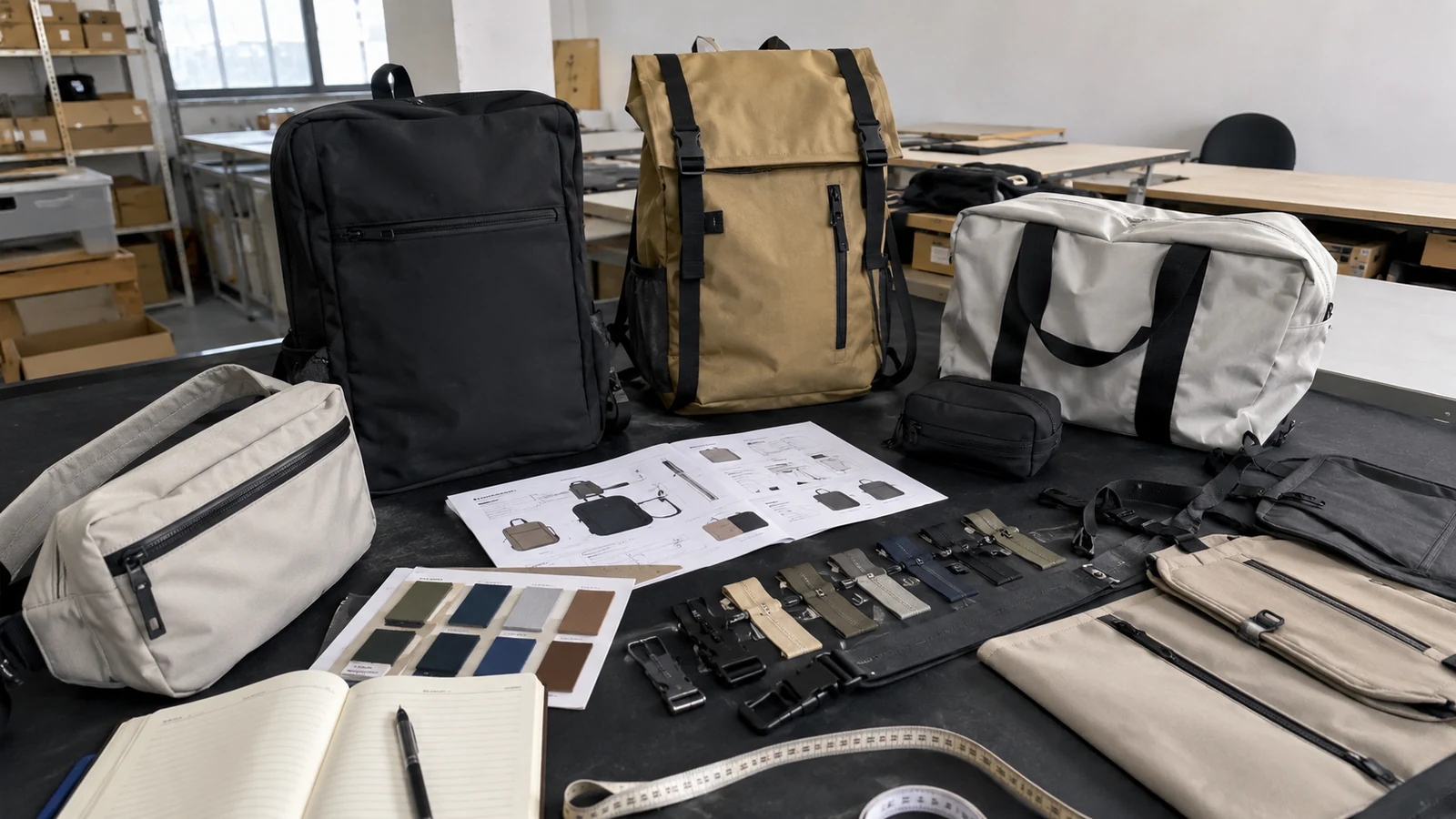
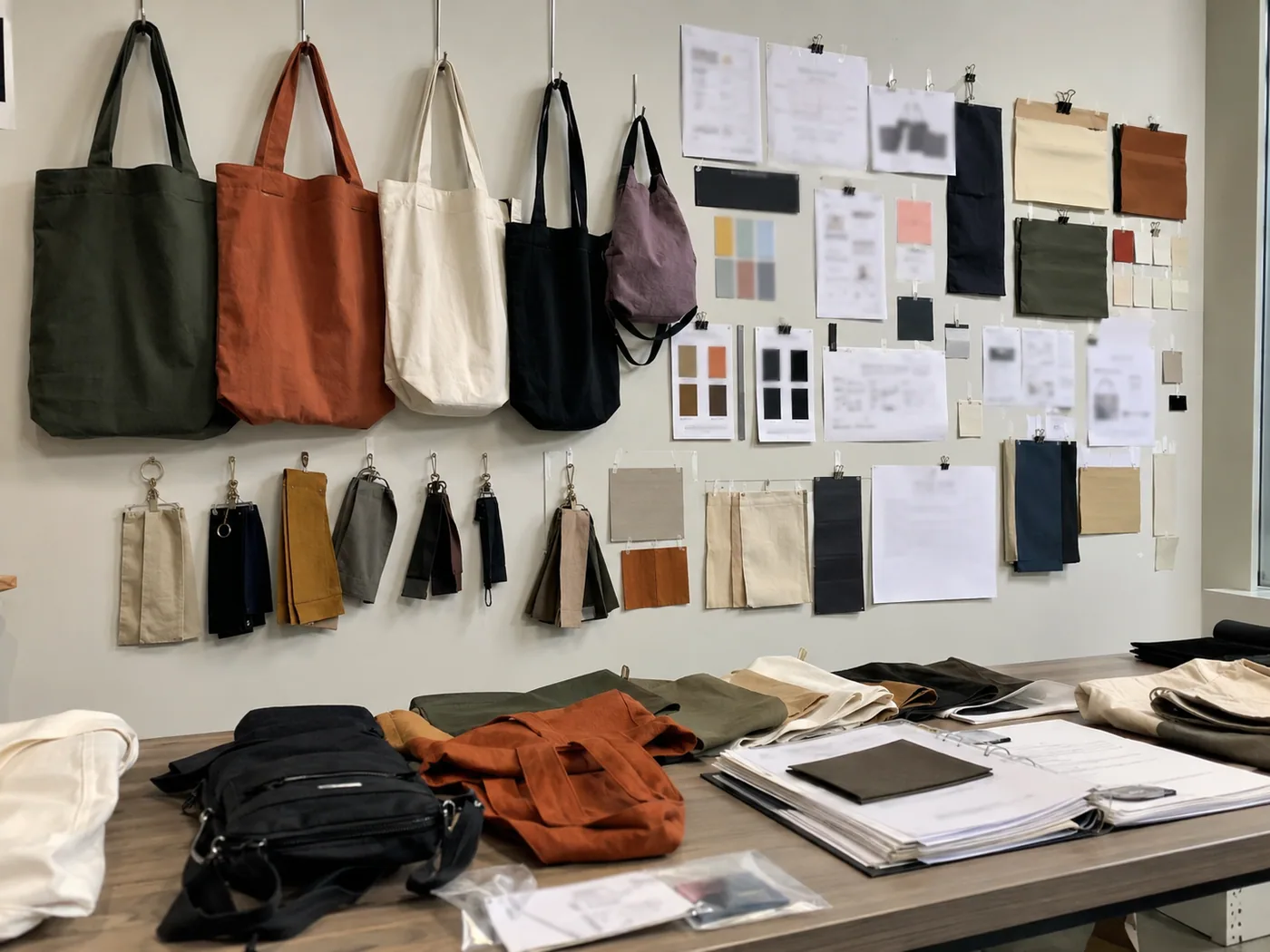
Bag development is visual and tactile. A drawing may define the outline, but the real decision happens when the buyer holds the sample, opens the zipper, checks the handle drop, studies the seam allowance, and compares the material to the brand standard. A China sampling setup is valuable because it allows close access to material markets, trim suppliers, pattern technicians, and sample makers. It also helps the buyer resolve design details before committing to larger production planning.
The sample development process must be treated as a controlled technical stage, not a casual pre-production step. Comments must be written in a way that can be repeated by production teams: change handle webbing from 30 mm to 38 mm, raise internal pocket by 15 mm, reduce logo plate thickness, adjust zipper opening, confirm lining color, or strengthen bottom binding. Vague comments such as make it nicer are difficult to translate into production instructions.
Sampling points that deserve attention
- Pattern accuracy: Confirm dimensions, seam placement, gusset shape, and pocket alignment.
- Material behavior: Check stretch, crease marks, coating feel, color consistency, and edge performance.
- Function: Test opening size, handle comfort, strap adjustability, zipper smoothness, and internal organization.
- Brand expression: Review logo placement, label scale, trim finish, and packaging hierarchy.
- Inspection logic: Decide which defects are critical, major, or minor before production starts.
How the China sampling plus Cambodia production model supports planning
For many B2B programs, the work is split between development and repeatable production. China sampling support helps the buyer refine the product while using nearby material and trim resources. Cambodia production can then be planned around approved samples, confirmed BOMs, production comments, and QC standards. This model is not about making promises before review; it is about separating the creative development stage from the controlled production stage.
Buyers should use the transition from sample approval to production planning to freeze key details. The team should confirm the approved sample version, material codes, color standards, hardware finish, logo artwork, packaging structure, carton marks, inspection checklist, and export documents. Connect5 can review this information through its capabilities workflow and sourcing coordination.
A useful rule for bag production is to freeze what affects function, cost, and inspection before bulk materials are ordered. Design flexibility is valuable during sampling, but late changes in production can create delays or rework.
MOQ, lead time, and quote preparation
MOQ and lead time depend on the bag type, material source, color count, hardware customization, labeling, packaging, and production schedule. A small cosmetic pouch with stock zipper tape is different from a structured handbag with custom metal trims, or a backpack with multiple compartments and foam reinforcement. Rather than asking for an absolute number at the first message, brands should share the target quantity and ask the factory team which factors may raise or lower the workable MOQ.
A quote should also define what is included. Sourcing teams should ask whether the price includes material, trims, logo application, inner packaging, export carton, testing support where required, and any special packing instruction. When comparing quotes, check if two suppliers are quoting the same material grade, lining, zipper quality, hardware finish, and packaging method. A low-looking price may simply reflect a different specification.
Questions to include in a quote review
- Which sample version and BOM is the quote based on?
- Are materials stock, semi-custom, or fully customized?
- How many colors and SKUs are included in the MOQ discussion?
- What packaging assumptions are used?
- Which inspection standard will be used before shipment?
- What information is still open and may affect the final price?
QC must be designed before production starts
Quality control is not only a final inspection. For bags, many defects are built into the product if the first production steps are not controlled. Stitch tension, edge painting, handle reinforcement, zipper alignment, binding, rivet pressure, and lining fit need clear workmanship expectations. The factory team should understand the buyer's market, acceptable tolerance, and packaging expectations before the order moves forward.
Connect5 provides a quality standards reference that buyers can use to prepare practical checks. The purpose is not to create paperwork for its own sake. It is to align the sample, production team, QC team, and buyer on what will be accepted, what must be reworked, and what needs confirmation before shipment.
FAQ
Can an OEM ODM bag manufacturer work without a complete tech pack?
Yes, the early discussion can start from reference images, dimensions, material direction, and target use. However, a cleaner technical file will make sampling, quoting, and production alignment more efficient. If the buyer does not have a full tech pack, the sample team can identify missing information for review.
Is ODM faster than OEM?
ODM may shorten the concept stage when the buyer adapts an existing construction direction. It still requires sample review, material approval, branding confirmation, packaging planning, and QC alignment. The actual timeline depends on the number of changes and the availability of materials and trims.
How should a brand compare two bag manufacturer quotes?
Compare the quoted sample version, material grade, zipper and hardware type, logo method, packaging, inspection expectations, and shipment terms. A quote that looks similar on the surface may be based on different construction assumptions.
When should we contact Connect5?
Contact the team when you can share the bag type, rough quantity, target market, material direction, branding requirement, and any reference sample or design file. Early review helps identify what must be sampled before bulk production planning.
Prepare your RFQ for Connect5
For a productive B2B discussion, prepare your bag brief, target quantity by SKU, material preferences, hardware notes, logo and packaging needs, target market, and required delivery window. Share your brief through Connect5 contact so the team can review whether OEM, ODM, or private label development is the appropriate route for your program.