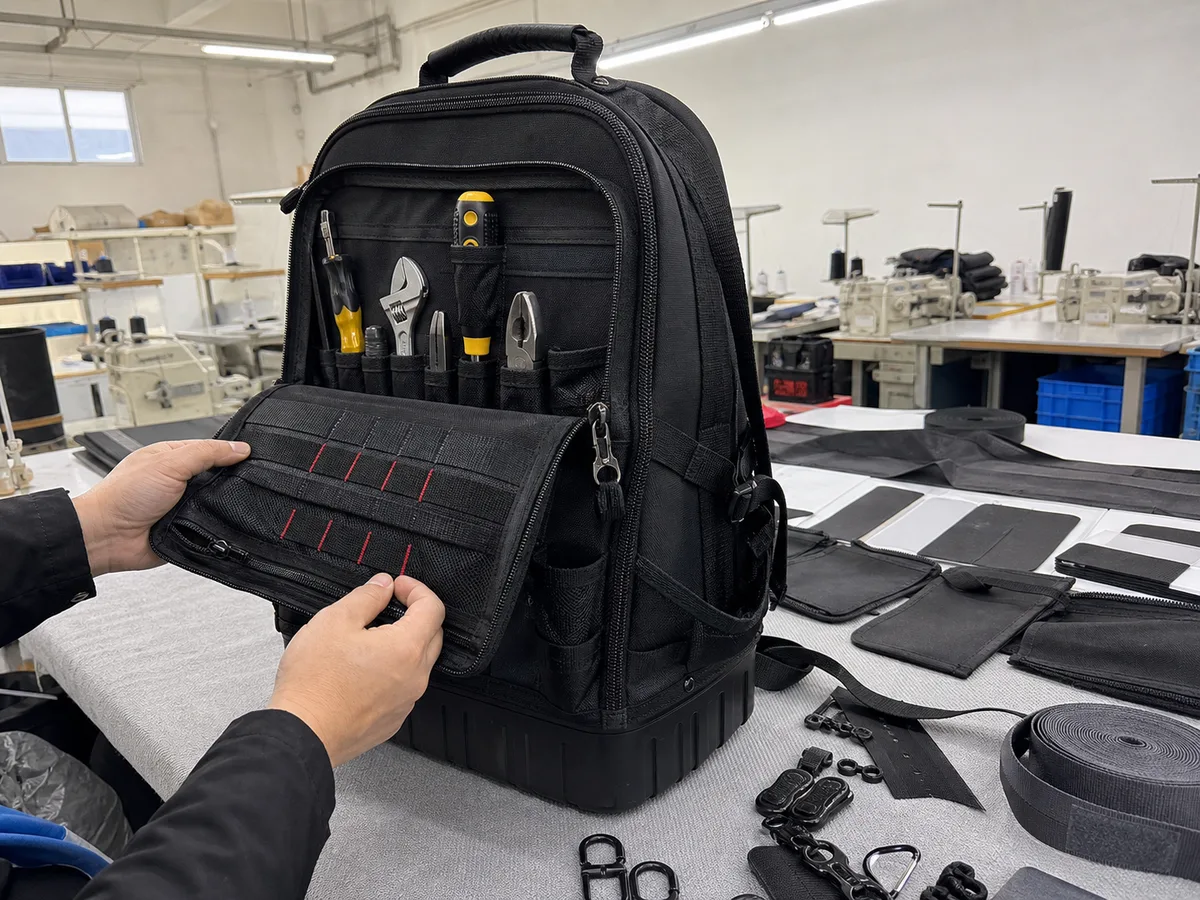
A private-label electrician tool backpack RFQ should define 5 inputs before sampling: trade user, loaded-weight target, tool list, bottom structure, and carton plan. For 2,000–5,000 pcs programs, these details prevent pocket-layout rework and handle or strap failures.
Start with the trade user, not the silhouette
Electrician, HVAC, telecom, contractor and MRO buyers often need different access patterns. A backpack, open-top tote or hard-bottom organizer can look similar in a photo, but pocket depth, vertical access, tool balance and jobsite handling change the manufacturing brief.
| Buyer program | Useful format | Critical decision before sample |
|---|---|---|
| Electrician kit | Tool backpack or open-top tote | Vertical screwdriver pockets, meter zone, cable storage and reinforced carry points. |
| HVAC field team | Technician backpack or hard-bottom bag | Loaded weight, wide opening, tool visibility and shoulder comfort. |
| Industrial distributor | Private-label tool bag range | Reusable pocket logic, logo method, carton marks and repeat-order consistency. |
Loaded weight decides reinforcement
Avoid select fabric and stitching before estimating loaded weight. Under 5 kg programs can use simpler reinforcement, while 10–15 kg programs usually need stronger webbing, board support, reinforced handles, strap anchors and stress-point stitching.
Pocket layout should follow a tool list
A tool backpack sample is easier to approve when the buyer sends an actual tool list. Screwdrivers, meters, pliers, drills, bits, tape, chargers and cables all need different pocket depths and retention points. If the tool list is not ready, ask the factory to build a first pocket map for review.
Hard-bottom choices affect durability and standing shape
| Bottom structure | Best fit | RFQ note |
|---|---|---|
| PE / PP board | Moderate load and cleaner retail shape | Confirm board thickness, lining wrap and bottom seam finish. |
| Molded rubber base | Heavy-duty field service and abrasion exposure | Confirm tooling, MOQ, standing shape, weight and sample timing. |
| Soft reinforced bottom | Lightweight organizer or lower-cost range | Confirm abrasion panels and carton packing so the shape does not collapse. |
RFQ checklist for private-label brands
- Target user: electrician, HVAC, mechanic, telecom, contractor, MRO or mixed field-service team.
- Format: backpack, open-top tote, rolling tool bag, pouch, organizer or hard-bottom bag.
- Loaded weight target: under 5 kg, 5–10 kg, 10–15 kg or buyer-defined tool list.
- Material: 1680D polyester, 900D polyester, ballistic nylon, lining, webbing and zipper preference.
- Structure: bottom board, molded base, reinforcement panels, handle and shoulder strap details.
- Branding and pack-out: logo patch, woven label, hangtag, barcode, carton marks and destination market.
QC points before export packing
Tool bags need practical QC: pocket placement, zipper movement, handle attachment, strap stress points, logo position, bottom shape, stitch strength and carton count. Ask for these checks before final release rather than only approving the exterior look.
Where to continue
Open the custom tool bag manufacturer route for the commercial RFQ page, compare reinforcement choices in the bag materials comparison chart, and use functional bag manufacturing if the project may also include delivery, equipment or emergency kit bags.
Send a tool bag RFQ with the target trade, quantity band, destination, tool list and sample deadline.
FAQ
What must be included in an electrician tool backpack RFQ?
Include the target trade, loaded-weight range, tool list, pocket map, bottom structure, fabric, reinforcement, logo method, packing requirements, quantity band, deadline and destination market.
Which materials are common for heavy-duty electrician tool backpacks?
Common options include 1680D or 900D polyester, ballistic nylon, reinforced webbing, PE or PP board support, molded rubber bottom panels, strong zippers and bar tack stitching at stress points.
Why does pocket layout need to be confirmed before sampling?
Pocket layout controls daily usability. Screwdrivers, meters, bits, drills and cables need different depths and access angles, so the sample must be built around a real tool list.
Can Connect5 support private-label electrician tool backpack programs?
Yes. Connect5 can review materials, structure, logo placement, sample needs, QC checkpoints and export packing for B2B private-label electrician and field-service tool backpack programs.